



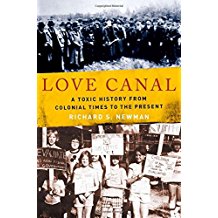
The winner for the 2015-2016 Malott Prize for Recording Community Activism is Love Canal: A Toxic History from Colonial Times to the Present, by Richard S. Newman (Oxford University Press, 2016).
Love Canal provides a clear description of the nation’s largest man-made disaster, now a byword for toxic environmental hazard.
 In the 1890s promoter William T. Love wanted to build a planned
city near Niagara Falls. To provide power for the town’s industry, he began a 15
foot deep canal to divert water from the Niagara River to the town site. His project
failed, and he was able to complete only about one mile of the canal. Twenty years
later the kaleidoscope of history had turned and the region had become
industrialized. Hooker Chemical Company played a dominant role. In the 1940s it
needed additional space to dispose chemical waste and purchased the old canal area.
Quite legally, armed with a permit from the City of Niagara Falls, the chemical
company began dumping toxic waste in 55 gallon drums in the old canal. In another 20
years the kaleidoscope turned once again, and a large increase of population brought
pressures for housing. Hooker gave the dump site, now attractively covered with
grass, to the City of Niagara Falls, which built a school and then sold the
remainder of the land to developers to build
In the 1890s promoter William T. Love wanted to build a planned
city near Niagara Falls. To provide power for the town’s industry, he began a 15
foot deep canal to divert water from the Niagara River to the town site. His project
failed, and he was able to complete only about one mile of the canal. Twenty years
later the kaleidoscope of history had turned and the region had become
industrialized. Hooker Chemical Company played a dominant role. In the 1940s it
needed additional space to dispose chemical waste and purchased the old canal area.
Quite legally, armed with a permit from the City of Niagara Falls, the chemical
company began dumping toxic waste in 55 gallon drums in the old canal. In another 20
years the kaleidoscope turned once again, and a large increase of population brought
pressures for housing. Hooker gave the dump site, now attractively covered with
grass, to the City of Niagara Falls, which built a school and then sold the
remainder of the land to developers to build  affordable single-family houses.
The toxic chemicals leaked out and by the late 1960s began causing significant illness and some death. By 1968 the residents of the community, especially housewives concerned about their own families, arouse in anger, demonstrated, petitioned, involved the media, to an extent never seen before concerning environmental issues. Their movement rolled like waves in the ocean, gaining in swell only to become calmed by government appeasement, then rising up once more. It garnered national attention. Ultimately the government bought out and resettled thousands of residents.
The Love Canal crisis generated profound ramifications. It fathered the national Superfund. More importantly it provided a model for local activists throughout the country. The Love Canal activists did not fold their tents and fade away following the resolution of their own problem. They remained active by advising and counseling countless others who suffered their own environmental problems. Especially active in this later work was Lois Gibbs, the housewife-turned-activist who vigilantly spearheaded the Love Canal Homeowners Association. Her vigilance in buttonholing officials was such that the Governor of New York remarked at the height of the protests that, with the exception of his wife, he saw Lois Gibbs more often than any other individual. In 1981, years after the Love Canal crisis had passed, Gibbs founded the Citizens’ Clearinghouse for Hazardous Wastes, a one-stop shopping center for local reformers. That organization has now morphed into the Center for Health, Environment & Justice, an organization with a broader agenda.
The book is a pleasure to read. Clearly written, it covers more than the Love Canal crisis itself, and contains a generous helping of the history of early European activity in the region, then the building of the canal, the Hooker Chemical era, and the subsequent residential development and chemical leachate that generated the crisis. It also pays attention to the personalities involved as well as the cultural norms that surrounded the building of the canal and the dumping of the chemicals. A thorough study. - DJL, Sr.
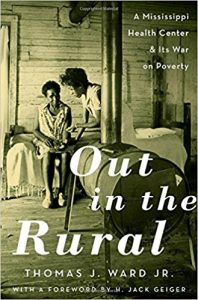
The finalist status for the 2015-2016 Malott Prize for Recording Community Activism goes to Out in the Rural: A Mississippi Health Center and Its War on Poverty, by Thomas J. Ward, Jr. (Oxford University Press, 2016).
 This work discusses the origins, operations, and present status of
a significant Great Society initiative of the 1960s: the Tufts-Delta Health Center
in Mound Bayou, Mississippi. This clinic opened in the fall of 1967, and suffered
significant contraction in the mid-1970s when funds were cut back for most of
President Johnson’s War on Poverty programs, but the health center survives today in
a smaller but stronger form.
This work discusses the origins, operations, and present status of
a significant Great Society initiative of the 1960s: the Tufts-Delta Health Center
in Mound Bayou, Mississippi. This clinic opened in the fall of 1967, and suffered
significant contraction in the mid-1970s when funds were cut back for most of
President Johnson’s War on Poverty programs, but the health center survives today in
a smaller but stronger form.
The health center provided a broad but usual spectrum of preventative care, illness management, and maternal care. It also had an unusually broad vision of “health,” and operated such additional programs as a farm project to assure nutritional food, a construction project to repair its patients’ shacks, and a bus service to bring patients to the clinic. For a time, it even operated an educational program to prepare residents to take the high school equivalency exam (GEDs) and an additional program to provide high school students with work-study classes. The clinic persuaded a nearby junior college to teach college-credited courses at the health center.
It would be difficult enough for the leadership of the clinic to face the normal
challenges of beginning  such an ambitious program. Yet Dr. Jack Geiger, the mainstay of
the enterprise, and his colleagues faced the additional challenge of local
opposition, and not only among the white Mississippians who thought the health
clinic was but a cover for civil rights activities. The black elite of Mound Bayou,
an unusual black-run community, also opposed the new health clinic. Local black
physicians and black owners of the two local black hospitals feared economic loss.
such an ambitious program. Yet Dr. Jack Geiger, the mainstay of
the enterprise, and his colleagues faced the additional challenge of local
opposition, and not only among the white Mississippians who thought the health
clinic was but a cover for civil rights activities. The black elite of Mound Bayou,
an unusual black-run community, also opposed the new health clinic. Local black
physicians and black owners of the two local black hospitals feared economic loss.
Reading this well-written and readable book leaves somewhat of a bittersweet taste. It was a noble task to build up all these far-flung programs to aid the rural and poor Mississippians. Yet the administrative strife and economic collapse that brought about considerable contraction in the 1970s is also disheartening. It is an interesting read. – DJL, Sr.